

Whole-home UV light installation is one of those indoor air quality upgrades that sounds simple on the surface, but there is more to it than just sticking a light inside the ductwork.
I have seen a lot of homeowners look into UV lights because they are dealing with musty smells, allergy concerns, mold worries, dirty evaporator coils, or they just want the air in the home to feel cleaner. Those are reasonable concerns. The problem is that UV lights often get explained in a way that makes them sound like they solve every indoor air quality problem by themselves.
They do not.
A UV light can be a useful part of a whole-home air quality setup when it is installed correctly and used for the right reason. But it is not a dust filter. It is not a dehumidifier. It is not a fresh air system. It is not going to magically fix poor airflow, dirty ductwork, bad filtration, or moisture problems in the home.
What it can do is help reduce certain biological growth inside the HVAC system, especially around the evaporator coil and drain pan where moisture is present. In some setups, UV can also help treat air passing through the system, but that depends heavily on lamp placement, airflow speed, lamp strength, exposure time, and the way the system is designed.
The best way to think about it is this:
A whole-home UV light is not the whole indoor air quality plan. It is one tool inside the plan.
When it is matched with good filtration, proper humidity control, clean airflow, and a well-maintained HVAC system, it can help keep the inside of the system cleaner and support better indoor air quality.
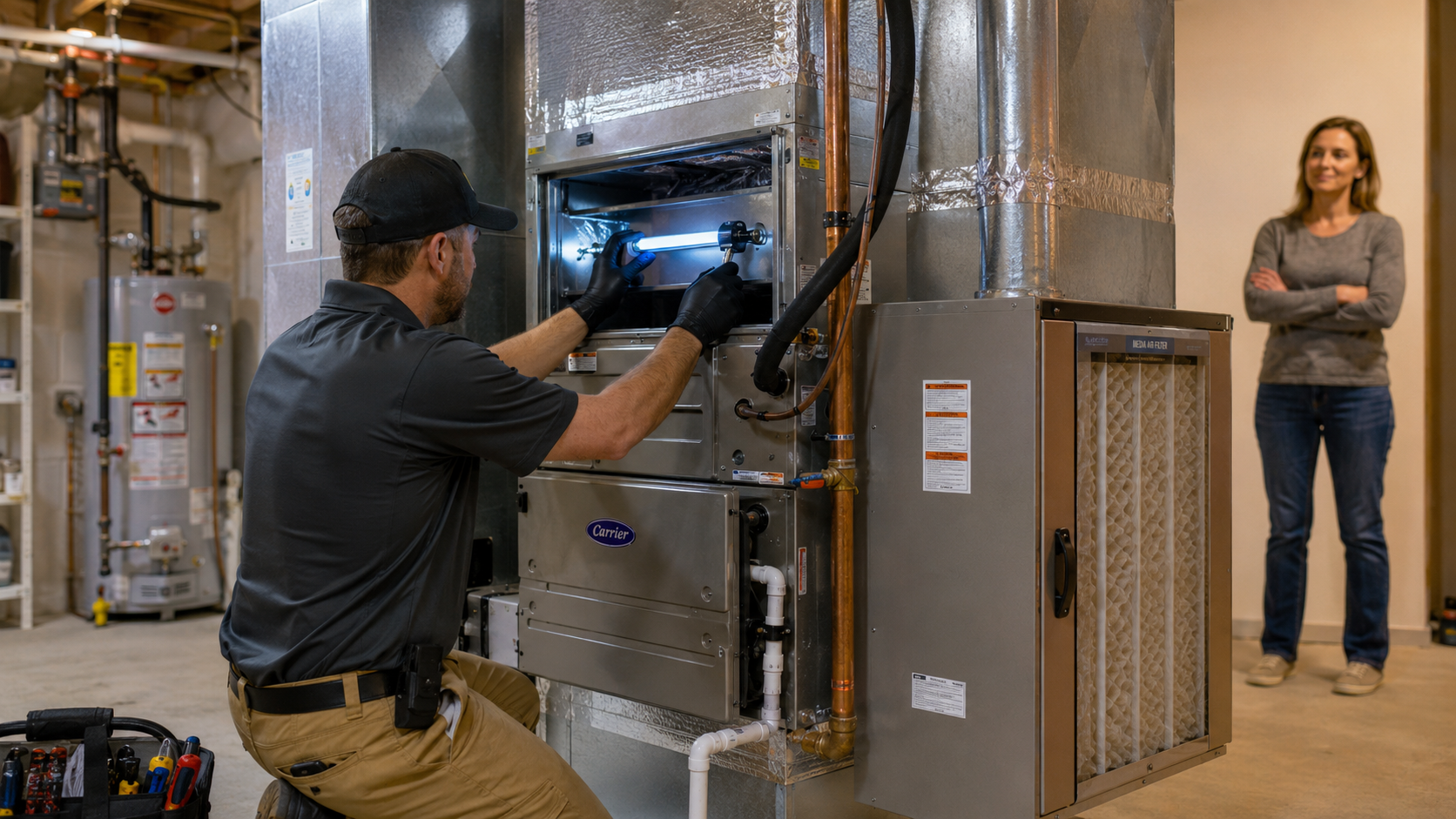
What a Whole-Home UV Light Actually Does
A whole-home UV light uses ultraviolet light, usually UV-C, inside part of the HVAC system. UV-C light is a type of ultraviolet light that can damage the DNA or RNA of certain microorganisms. In plain English, it can help stop some bacteria, mold, and other biological material from growing or reproducing when they are exposed to enough UV energy for enough time.
That last part matters.
UV light is not magic. A microbe has to be exposed to the light long enough, at the right intensity, and at the right distance. If air is moving too fast or the lamp is too weak, the results will not be the same as a properly designed setup.
In residential HVAC systems, UV lights are usually used in two main ways.
Coil surface treatment
This is the most common and practical use in many homes.
The UV lamp is installed so it shines on the evaporator coil, drain pan, and nearby surfaces. The evaporator coil is the cold coil inside your indoor HVAC equipment during air conditioning season. Warm indoor air passes over that cold coil, moisture condenses on it, and the water drains away through the condensate system.
That coil is dark, damp, and often covered with small amounts of dust and organic material. That makes it a place where microbial growth can sometimes develop.
A coil-mounted UV light helps keep that surface cleaner by shining continuously on the coil and drain pan area. It is not there to “scrub” the air in one pass. It is mainly there to prevent or reduce biological buildup on wet HVAC surfaces.
From a technician’s point of view, this is where UV lights tend to make the most sense.
A cleaner coil can mean better airflow, better heat transfer, less musty odor from the equipment, and fewer issues caused by buildup on the coil surface.
Air stream treatment
Some UV systems are installed inside the ductwork to expose moving air to UV light. This is usually called in-duct UV or air-stream UV.
This type of setup is more sensitive to design. Air moves through residential ductwork quickly. For UV to affect airborne particles or microbes, the light intensity and exposure time have to be right. That is why air-stream UV performance can vary a lot depending on equipment, duct size, fan speed, lamp output, and placement.
This does not mean in-duct UV is useless. It just means the design matters.
A small lamp installed in the wrong place with high airflow moving past it may not do much to the air. A properly selected and installed system can perform better, especially when used with strong filtration and good airflow design.
Why Homeowners Consider UV Light Installation
Most homeowners do not wake up one day thinking about ultraviolet germicidal irradiation. They start looking at UV because something in the home does not feel right.
Maybe the house smells musty when the air conditioner starts. Maybe someone in the home has allergies. Maybe the evaporator coil has had slime or biological growth on it before. Maybe the homeowner keeps changing filters but the house still feels dusty or stale.
Those concerns are common.
The trick is figuring out whether UV is actually the right tool for the problem.
A whole-home UV light may make sense when there are signs of biological growth inside the HVAC system, repeated coil cleanliness issues, musty odors coming from the air handler, or a damp indoor coil environment. It may also make sense for homeowners who are building a layered indoor air quality system and already understand that UV is one piece of the setup.
Here are some situations where UV is worth looking at:
- The evaporator coil has visible buildup or biological growth.
- The air handler smells musty when cooling starts.
- The drain pan has recurring slime or growth.
- The home has high indoor humidity during cooling season.
- The HVAC system runs long hours and stays damp often.
- The homeowner wants added protection beyond filtration.
- The system already has decent airflow and filtration.
There are also situations where UV should not be the first fix.
If the home has a cheap filter, leaky return ducts, poor humidity control, dirty ductwork, or an oversized air conditioner that does not run long enough to remove moisture, those issues should be addressed first. UV can help with biological growth, but it will not fix the root cause of every indoor air problem.
I like to explain it this way:
If your coil is staying wet, dirty, and dark, UV can help control what grows there. But if your system has poor airflow, bad filtration, or moisture problems, those still need to be corrected.
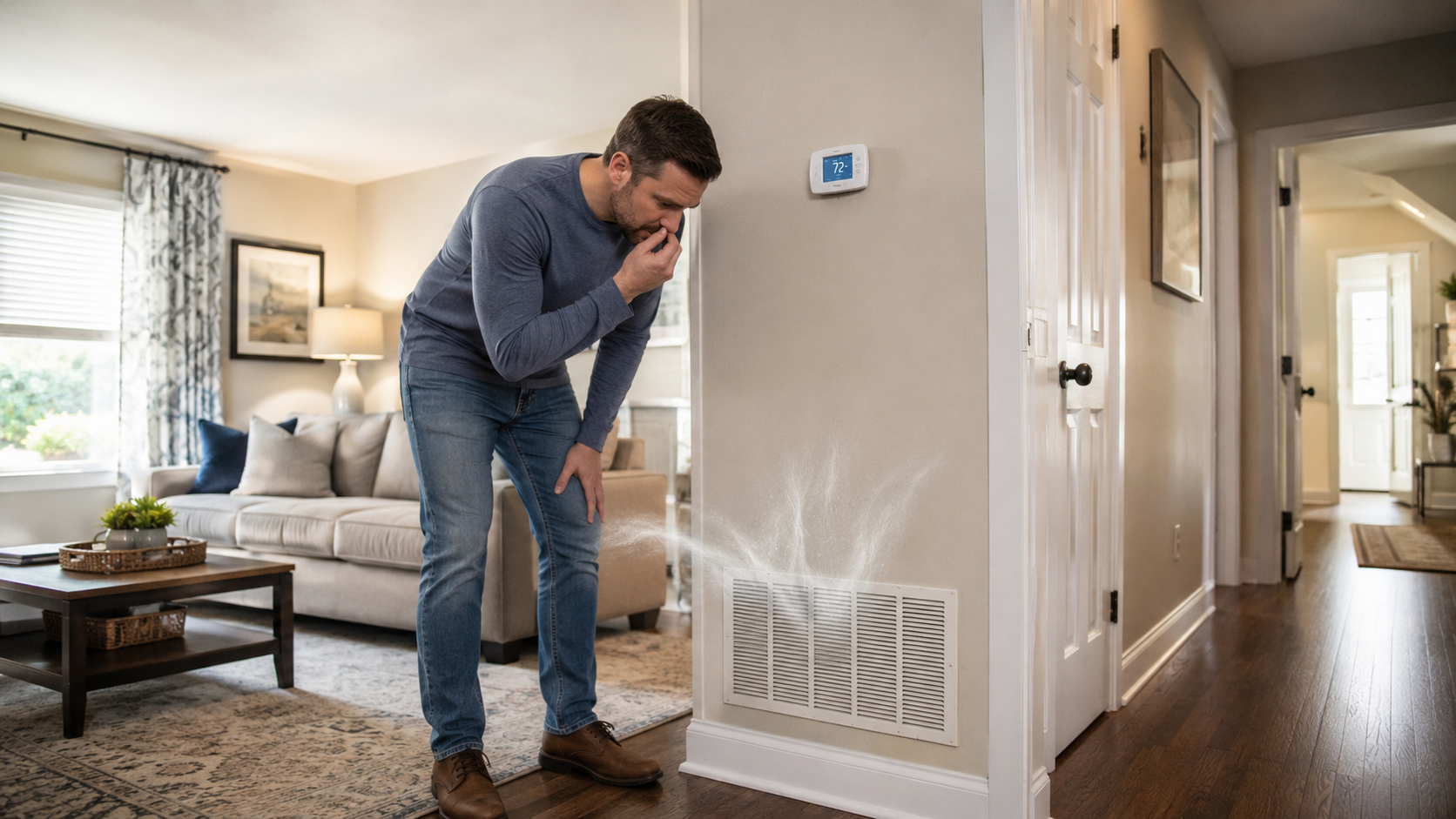
How UV Lights Fit Into a Complete Indoor Air Quality Plan
A lot of indoor air quality problems are connected. Dust, humidity, airflow, filtration, odors, and biological growth all affect each other.
That is why I do not like treating UV lights like a standalone cure.
A good indoor air quality setup usually has layers. Each layer handles a different type of problem.
Filtration handles particles
Your HVAC filter is the first line of defense for particles. That includes dust, pollen, pet dander, lint, and some smaller airborne particles depending on the filter rating.
UV light does not catch dust. It does not remove pet hair. It does not trap pollen. If someone sells UV as a replacement for a good filter, that is not a complete explanation.
A better filter cabinet or properly selected media filter is often one of the most important indoor air quality upgrades in a home. But the filter has to match the system. A filter that is too restrictive can hurt airflow and raise static pressure.
Static pressure is basically the resistance the blower has to push against. If the system is too restricted, you can end up with weak airflow, noisy ducts, frozen coils, comfort problems, and equipment stress.
So filtration matters, but it has to be done correctly.
Humidity control handles moisture
Moisture is a big part of indoor air quality.
If indoor humidity is too high, the home can feel sticky, odors can become stronger, dust mites can become more of a problem, and biological growth is more likely in damp areas. In many homes, humidity control does more for comfort and air quality than people expect.
UV can help reduce growth on the coil surface, but it does not remove moisture from the air. If the home has high humidity, that should be diagnosed separately.
Sometimes the answer is better HVAC sizing, longer run times, blower speed adjustment, a whole-home dehumidifier, duct sealing, or better ventilation control.
Ventilation handles stale indoor air
Homes need some level of fresh air exchange. Too little ventilation can make the home feel stale and allow indoor pollutants to build up. Too much uncontrolled ventilation can bring in humidity, pollen, outdoor pollution, or temperature swings.
UV does not bring in fresh air.
If a home has odors, chemical smells, high carbon dioxide levels, or general stuffiness, ventilation may need to be looked at. That could mean controlled fresh air, an energy recovery ventilator, better exhaust operation, or sealing problems that are pulling air from attics, crawlspaces, garages, or wall cavities.
UV helps with biological growth in the system
This is where UV fits best.
It can help control biological material on damp HVAC surfaces and support a cleaner indoor coil area. That can be especially helpful in climates or homes where the air conditioner runs often and the coil stays wet for long periods.
The best results usually come when UV is paired with:
- A properly sized HVAC system
- Good filtration that does not choke airflow
- Controlled indoor humidity
- Clean ductwork and return air paths
- Regular HVAC maintenance
When all of those pieces work together, the home has a much better chance of feeling clean, comfortable, and consistent.
Where a Whole-Home UV Light Is Installed
Most residential UV lights are installed in or near the indoor HVAC equipment. The exact location depends on the system layout, the type of UV light, the goal of the installation, and access for future service.
A technician should not just pick a random spot in the duct and drill a hole. Placement matters.
Near the evaporator coil
This is one of the most common locations.
The lamp is positioned so the UV light shines directly on the evaporator coil and drain pan area. This helps target the surfaces most likely to stay damp during cooling season.
In many homes, this is the most practical setup because the coil is where biological growth is most likely to become a system issue.
The installer needs to make sure the UV light is aimed properly, has enough clearance, does not damage nearby materials, and can be serviced later without tearing the system apart.
Inside the supply plenum
The supply plenum is the section of ductwork right after the air handler or furnace where conditioned air leaves the equipment and moves into the home.
Some UV systems are installed here to treat air as it leaves the equipment. This can work in certain designs, but the installer needs to think about airflow speed, lamp exposure, duct dimensions, and safety.
The lamp should not be installed where it shines directly onto materials that are not rated for UV exposure. Some plastics, filter materials, wiring insulation, and drain components can degrade over time if they are exposed to UV light.
Inside the return duct
The return duct brings air from the home back to the HVAC system.
Return-side installation may be used in some setups, but it is not always the best choice. The return side can be dusty, and dust buildup on the lamp can reduce UV output. Also, if the goal is coil protection, the lamp usually needs to shine on the coil area instead.
This is why a real installation starts with looking at the equipment, not just selling a box.
Access and service location
A UV lamp needs maintenance. The bulb will not last forever. Even if the light still glows, the useful UV output drops over time.
That means the lamp location should be serviceable. A technician should be able to inspect it, replace the bulb, and check the wiring without major trouble.
A clean-looking installation matters too. The wiring should be secured, the transformer or power supply should be mounted properly, and access panels should still open correctly.
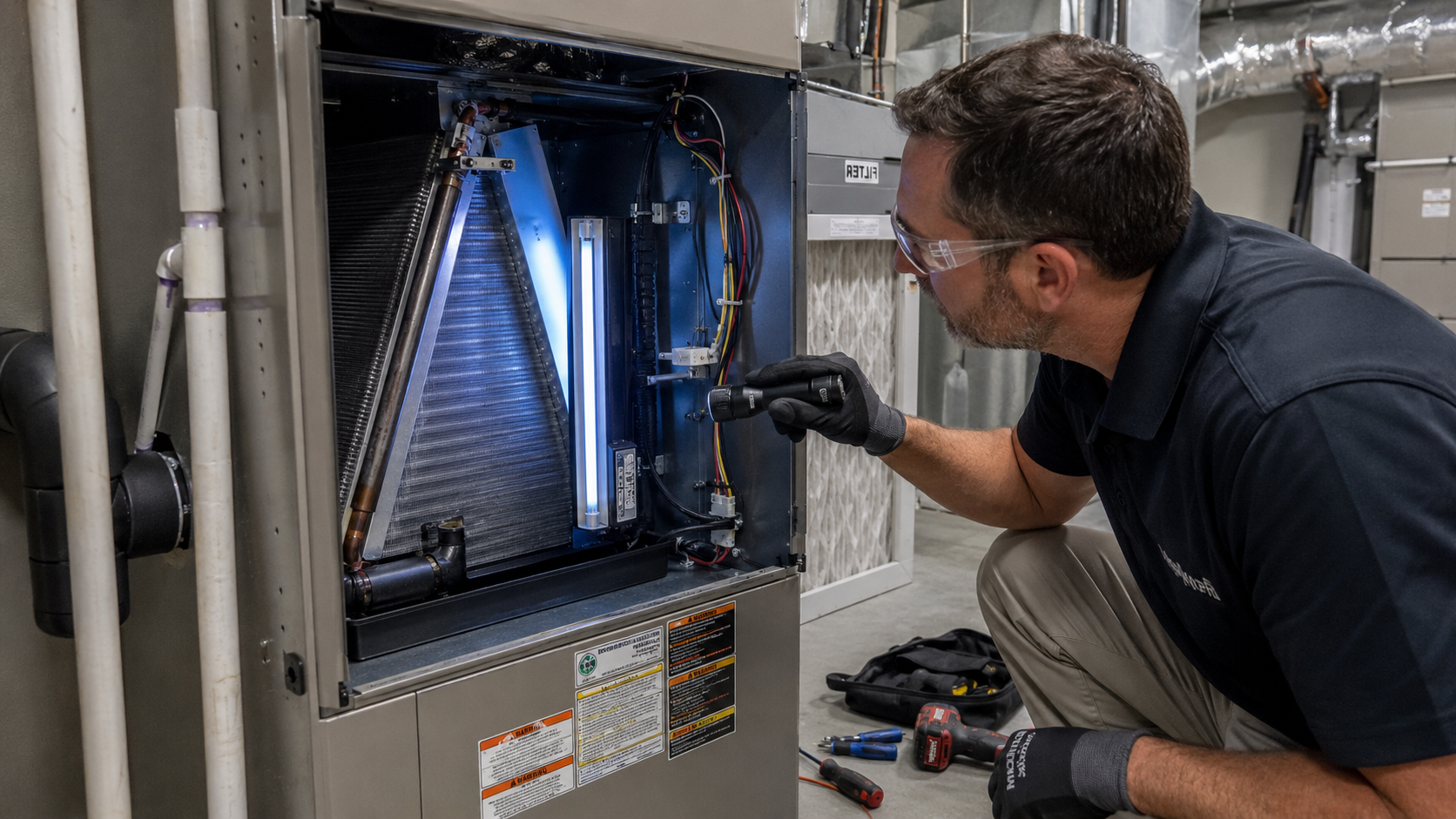
What Happens During a Professional UV Light Installation
A proper whole-home UV light installation is not usually a huge project, but it should still be done carefully.
The technician needs to inspect the system, choose the right location, protect the equipment, wire the light safely, and make sure the homeowner understands maintenance.
System inspection
Before installing anything, the HVAC system should be looked over.
A technician should check the air handler or furnace, evaporator coil access, duct layout, filter setup, condensate drain, wiring options, and general cleanliness of the system.
If the coil is already heavily impacted with dirt or growth, it may need to be cleaned before the UV light is installed. UV is better at helping keep a clean surface clean than fixing a severely neglected coil by itself.
The technician should also look for signs of bigger problems, such as:
- High indoor humidity
- Poor filter fit
- Water sitting in the drain pan
- Air bypass around the coil
- Dirty blower wheel
- Restricted airflow
- Duct leakage near the equipment
- Past condensate drain issues
Those issues matter because UV should not be used to hide a system problem.
Choosing the right UV system
Not every UV light is the same.
Some are basic single-lamp systems. Some use dual lamps. Some are designed mainly for coil treatment. Others are designed for in-duct air treatment. Some include a sight glass, status indicator, or replaceable lamp cartridge.
The right option depends on the system and the goal.
For a normal residential installation, I would rather see a properly placed, well-built UV system than an oversized or poorly placed one. Bigger is not always better if it is installed wrong.
The lamp should also be designed for HVAC use. Random UV products are not the same as HVAC-rated UV systems. The housing, wiring, lamp coating, safety labeling, and installation method all matter.
Cutting and mounting
Once the location is selected, the technician marks the duct or cabinet, cuts the proper opening, and mounts the UV assembly.
This should be done neatly. Metal shavings should not be left inside the equipment. The light should be mounted securely. Any openings should be sealed according to the product instructions so air does not leak around the installation.
The lamp should be positioned so it does its job without shining where it should not.
Electrical connection
Many UV lights are wired to operate when the HVAC system has power. Some run continuously. Others may be wired to operate with the blower.
There are pros and cons depending on the setup.
For coil treatment, continuous operation is common because the goal is to keep the coil and drain pan exposed to UV over time. For air-stream treatment, some systems may be tied more closely to blower operation.
Electrical work should be done safely and according to the manufacturer’s instructions. Power should be shut off before installation. Wiring should be secured. The transformer or power supply should be mounted where it is protected and accessible.
Startup and verification
After installation, the technician should confirm that the UV light powers on, the access panels are secure, and the homeowner knows how to tell whether the system is operating.
The homeowner should also be told not to stare directly at UV light and not to remove panels while the lamp is energized.
UV-C light can be harmful to eyes and skin. A properly installed system keeps the light contained inside the HVAC equipment or ductwork.
What UV Lights Can and Cannot Do
This is the section I wish every homeowner read before buying a UV light.
UV lights can be helpful, but expectations need to be realistic.
What UV can help with
A whole-home UV light can help reduce biological growth on HVAC surfaces that are exposed to the lamp. This is especially useful around the evaporator coil and drain pan.
It may also help reduce certain airborne biological contaminants when the system is designed for air-stream treatment, but that depends on exposure time, airflow, lamp strength, and placement.
UV can also help with some musty odors that originate inside the HVAC equipment. If the smell is coming from microbial growth on a damp coil or drain pan, UV may help reduce that source over time.
What UV does not fix
UV does not remove dust from the air. It does not catch pollen. It does not remove pet dander. It does not absorb chemical odors. It does not fix high humidity. It does not clean dirty ductwork. It does not correct poor airflow.
That means UV should not be treated as a replacement for:
- Good HVAC filtration
- Proper filter changes
- Coil cleaning when needed
- Humidity control
- Duct sealing
- Ventilation improvements
- Regular HVAC maintenance
It also will not solve every odor.
If the smell is coming from a crawlspace, attic, drain issue, sewer gas, wet building materials, pets, smoke, or VOCs from household products, a UV light in the HVAC system may not address the real source.
That is why diagnosis matters.
Why ozone matters
Homeowners should be careful with any device that intentionally produces ozone.
Ozone is not something you want added to occupied indoor air. It can irritate the lungs and is not the same thing as clean air. Some air cleaning products use confusing language around “activated oxygen” or similar terms. Homeowners should understand what the device actually produces before installing it.
For residential HVAC use, I prefer UV systems designed for indoor HVAC applications that do not intentionally generate ozone.
Clean air should not come with a lung irritant as a tradeoff.
Maintenance After UV Light Installation
A UV system is not a set-it-and-forget-it upgrade.
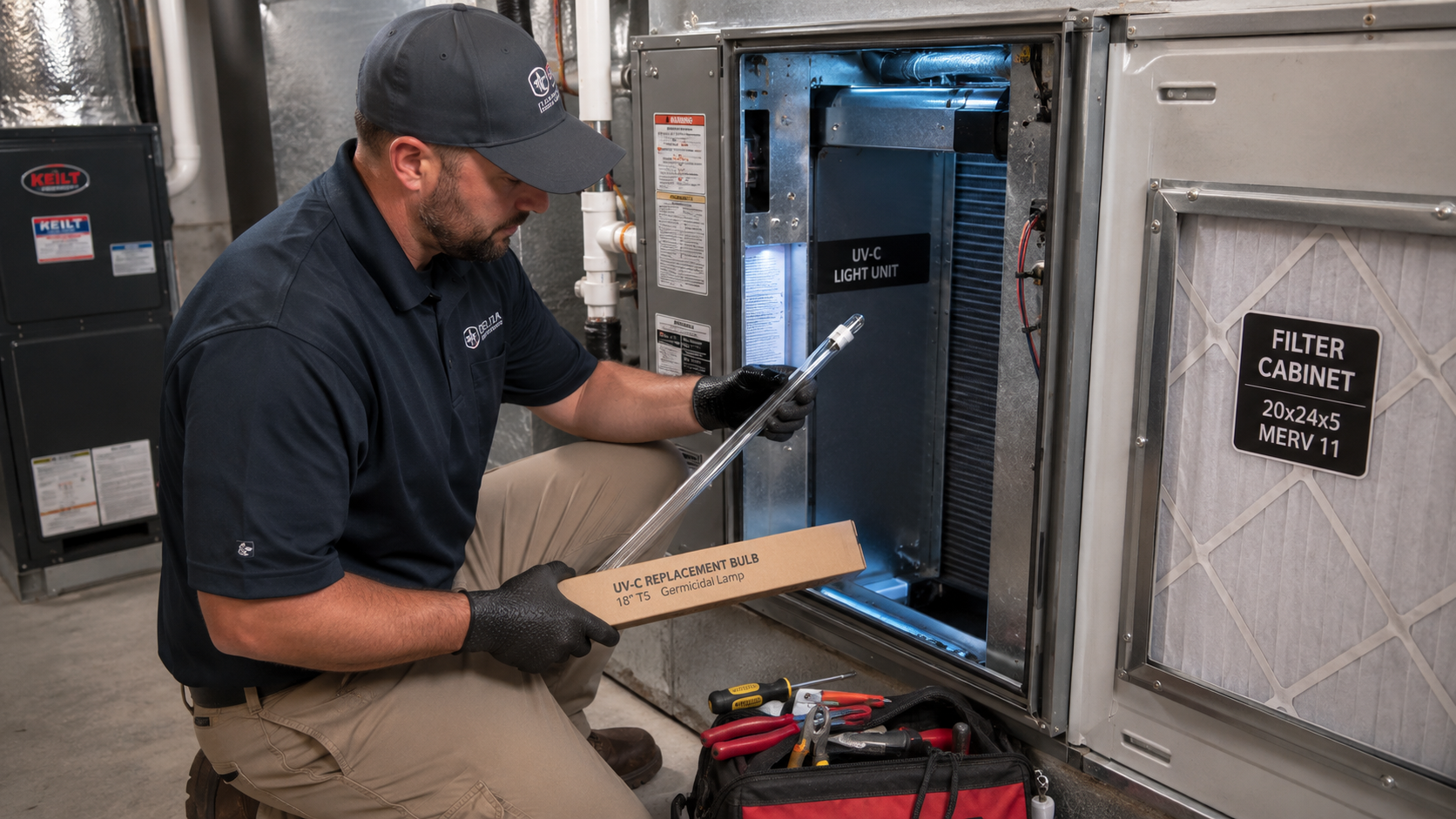
The bulb needs to be replaced on schedule. In many residential systems, that is commonly around once a year, but the exact timing depends on the product. Some lamps are rated longer, but homeowners should follow the manufacturer’s replacement schedule.
Here is the part that surprises people:
A UV bulb can still glow even when its germicidal output has dropped.
So looking at the light and saying, “It still turns on,” does not always mean it is still doing its job at full strength.
The lamp can also get dusty. Dust on the bulb can block UV output. During HVAC maintenance, the technician should inspect the UV system, check the lamp condition, verify operation, and replace the bulb when needed.
The surrounding area should also be inspected.
If the coil is still getting dirty, the filter setup may need attention. If the drain pan still has slime or standing water, the condensate system may need cleaning or repair. If the home still smells musty, the odor source may be somewhere else.
UV maintenance should be part of a bigger HVAC maintenance routine.
A practical maintenance plan includes:
- Replace the UV bulb on schedule.
- Keep the HVAC filter changed.
- Inspect the evaporator coil and drain pan.
- Keep the condensate drain clear.
- Check humidity levels in the home.
- Make sure airflow is not restricted.
- Confirm the UV system is safely mounted and operating.
When homeowners keep up with those basics, UV has a much better chance of doing what it is supposed to do.
Is Whole-Home UV Light Installation Worth It?
A whole-home UV light can be worth it when it is installed for the right reason.
If the goal is to help keep the evaporator coil cleaner, reduce biological growth on damp HVAC surfaces, and support a layered indoor air quality strategy, UV can make a lot of sense.
If the goal is to remove dust, eliminate every odor, cure allergies, replace filtration, or fix a moisture problem, UV is not the right standalone answer.
The value depends on the home, the HVAC system, and the problem you are trying to solve.
For some homes, I would recommend improving filtration first. For others, I would look at humidity control. In homes with recurring coil growth or musty air from the air handler, UV may be a smart addition after the system is cleaned and inspected.
The best installations usually start with a few simple questions:
What problem are we trying to solve?
Where is the source of the problem?
Is the HVAC system clean enough for UV to help?
Is the filter setup doing its job?
Is humidity under control?
Is the UV light being installed in the right place?
That is how a technician thinks through it.
Not every home needs UV. But for the right home, with the right setup, it can be a useful part of a cleaner and healthier indoor environment.
At American Air Purification, the goal is to help homeowners understand these options clearly before making a decision. Whole-home UV light installation should be explained honestly, with the benefits and limitations laid out in plain English.
That is how homeowners make better decisions.
Not by itself. A UV light can help treat certain biological contaminants when they are exposed to enough UV energy, but it does not remove dust, pollen, pet dander, or chemical odors from the air. It works best as part of a larger indoor air quality setup that includes good filtration, airflow, humidity control, and regular HVAC maintenance.
Most whole-home UV lights are installed near the evaporator coil, inside the air handler, or in the ductwork near the indoor HVAC equipment. The best location depends on whether the goal is coil surface treatment or air-stream treatment. A technician should inspect the system before choosing the location.
Many residential UV bulbs are replaced about once per year, but the exact schedule depends on the specific product. The bulb may still glow even after its useful UV output has dropped. That is why it should be replaced based on the manufacturer’s schedule, not just whether it still lights up.
It may help if the musty smell is coming from biological growth on the evaporator coil, drain pan, or nearby HVAC surfaces. If the odor is coming from duct leakage, crawlspace air, moisture in building materials, pets, smoke, plumbing issues, or household chemicals, UV may not solve the source. The smell should be diagnosed before assuming UV is the answer.
A properly installed HVAC UV light is designed to keep UV exposure contained inside the equipment or ductwork. Homeowners should not stare at the lamp or remove access panels while the light is on. It is also important to choose HVAC-rated equipment that does not intentionally produce ozone for occupied indoor air.