

.svg)


What Overland Park Homeowners Should Know About Their Indoor Air Quality
Overland Park homes deal with a little bit of everything when it comes to indoor air quality. You have hot, humid summers, cold winters, heavy spring pollen, fall ragweed, finished basements, mature trees, busy roads, newer tight homes, older duct systems, and long stretches of the year where the house stays closed up. That combination can create problems that do not always show up as one obvious issue. A homeowner may call it dust. Another may call it allergies. Someone else may describe a musty smell when the air conditioner starts. A lot of the time, those complaints are connected.
One thing I notice with homes in Overland Park is that the indoor air problem usually is not just one thing. It is rarely only the filter. It is rarely only the ductwork. It is rarely only the humidity. Most homes have a few small issues stacking on top of each other. A basic filter that does not fit tight in the rack, a return duct pulling air from a basement cavity, a damp coil, a finished basement holding moisture, pets in the home, and spring pollen coming in through doors and windows can all work together. By the time the homeowner notices symptoms, the system has already been moving that air around the house for weeks or months.

Why Overland Park Homes Have Their Own Indoor Air Quality Pattern
Overland Park sits in Johnson County, but from an air quality standpoint it is tied closely to the larger Kansas City metro. The air outside the home changes with the season, the wind, the road traffic, the humidity, and even regional smoke events. During the warmer months, the Kansas City area has an ozone season that runs from early spring into the fall. The worst alerts are usually during the hotter, sunnier stretch of summer. That matters indoors because homeowners often think of air pollution as something that stays outside, but houses are not sealed containers.
Every home leaks air somewhere. Older homes may leak around rim joists, attic bypasses, basement penetrations, older windows, electrical openings, and leaky return ducts. Newer homes are usually tighter, but they can still bring in outdoor air through bath fans, range hoods, dryer vents, attic leaks, garage connections, and pressure imbalances from the HVAC system. When the air outside is carrying pollen, smoke, fine dust, ozone-related pollutants, or lawn debris, some of that makes its way inside.
The tree cover in Overland Park is part of what makes many neighborhoods nice to live in, but it also plays a role in indoor air complaints. In spring, mature trees can load the outside air with pollen. Homeowners notice it on cars, patio furniture, window screens, and porch surfaces. What they do not always think about is how easily that same pollen gets tracked indoors. It comes in on shoes, dogs, clothing, open doors, and leaky ductwork. Once it gets inside, the HVAC system can either capture some of it or keep circulating it, depending on the filter setup, return design, blower condition, and how much air actually passes through the filter.
Overland Park also gets enough rainfall for moisture to matter. Basements are common, and many of them are finished. A finished basement can look clean and comfortable while still hiding moisture behind walls, under carpet, near foundation edges, or around duct chases. When the basement air smells a little earthy or musty, the HVAC system may pull that air into the rest of the home if returns are located nearby or if the house pressure encourages basement air to move upward. That is one reason a smell noticed downstairs can eventually become a whole-house complaint.
Dust, Pollen, and the Filter Problem Most Homeowners Miss
Dust complaints in Overland Park homes are common, but dust is not always the same dust from house to house. In one home, the dust may be mostly skin cells, fabric fibers, pet dander, and carpet particles. In another, it may be attic dust or basement dust getting pulled into the return side of the system. A house near a busy stretch of Metcalf, 95th Street, College Boulevard, U.S. 69, or I-435 may also see more fine particles from outdoor traffic and road dust. Homes near active construction or new development can have a different kind of dust load entirely.
A lot of homeowners assume that if they are changing the filter, filtration is handled. That is not always true. Many standard 1-inch filters are built more to protect the blower and coil than to clean the air at a high level. They catch larger material, but smaller particles can pass through. On the other side, some homeowners install a very restrictive high-MERV filter in a system that was not designed for it. That can reduce airflow, raise static pressure, make the blower work harder, and cause comfort problems. Better filtration is useful, but it has to match the duct system.
Common signs that filtration is not keeping up include:
- Dust returning quickly after cleaning
- Dark buildup around supply registers
- Filters bowing, collapsing, or getting pulled out of shape
- Allergy symptoms that feel worse indoors during spring or fall
- Pet odor or dander that seems to linger
- Visible dust inside return grilles or filter cabinets
After seeing symptoms like that, the first thing I would want to know is not just what filter is installed. I would want to know how the filter fits, whether air can bypass around it, what the return duct looks like, how much static pressure the system is seeing, and whether the blower wheel and coil are clean. A good filter cannot do its job if air is sneaking around it. It also cannot fix a return duct that is pulling dusty air from a basement, attic, wall cavity, or mechanical room.
This is where whole-home air purification can help, but only when it is treated as part of the HVAC system rather than a magic box. A media filter, HEPA filtration setup, UV light, or other air purification equipment should be matched to the home’s actual problem. If the issue is fine dust and allergies, filtration matters most. If the issue is musty odor from the coil area, UV may make more sense. If the issue is stale air in a newer tight home, ventilation may need to be part of the conversation. The right answer depends on what is happening inside that specific house.
Seasonal Indoor Air Quality Problems in Overland Park
The indoor air in Overland Park changes throughout the year. That may sound obvious, but it is one of the most important things homeowners can understand. If a home feels dusty in February, smells musty in July, and causes allergy symptoms in September, those are probably not three separate mysteries. They are seasonal conditions showing up through the same house and HVAC system.
Spring tends to bring tree pollen, wet soil, damp basements, and filters that load faster than homeowners expect. If the furnace or air handler has a loose filter slot, spring pollen finds its way around the filter and into the duct system. If the home has pets, pollen can ride in on fur and then settle into carpets, furniture, bedding, and return grilles. This is when people often start noticing yellow dust, irritated eyes, sneezing indoors, and supply vents that look dirty again shortly after cleaning.
Summer is when humidity becomes the bigger issue. Air conditioners remove moisture, but only when they run long enough and are operating correctly. If the system is oversized, short cycling, low on airflow, dirty at the coil, or not draining properly, humidity can remain elevated. In a finished basement, that damp feeling may show up before anyone sees visible moisture. Sometimes the first clue is a musty smell when the AC starts, especially if the evaporator coil, drain pan, or nearby duct liner has biological buildup.
Fall brings ragweed, mold spores, leaf debris, and a different kind of dust complaint. Ragweed around the Kansas City area can become noticeable around mid-August and last well into October. During that same stretch, homeowners may open windows on mild days, mow leaves, clean up yards, and run the HVAC system less consistently. That stop-and-start pattern can let particles settle in the home, then get stirred up when the blower kicks back on.
Winter creates almost the opposite problem. Homes stay closed. Furnaces run. Indoor relative humidity often drops. Pet dander, dust, cooking particles, fireplace odors, and household VOCs can build up because there is less fresh air coming in. Dry air can make dust feel worse because irritated noses and throats become more sensitive. A homeowner may describe it as “bad air,” when part of the issue is low humidity, part is particle buildup, and part is lack of ventilation.
A simple way to think about the year:
- Spring: tree pollen, damp basements, fast-loading filters
- Summer: humidity, musty AC odors, coil and drain pan concerns
- Fall: ragweed, mold spores, leaf debris, dusty ducts
- Winter: dry air, stale air, pet dander, closed-up homes
That seasonal pattern is why the same air purification setup is not perfect for every house. Some homes need better particle capture. Some need humidity control. Some need coil treatment. Some need ventilation. Many need a combination, but the order matters. I would rather fix the biggest root cause first than install equipment that only hides the symptom.
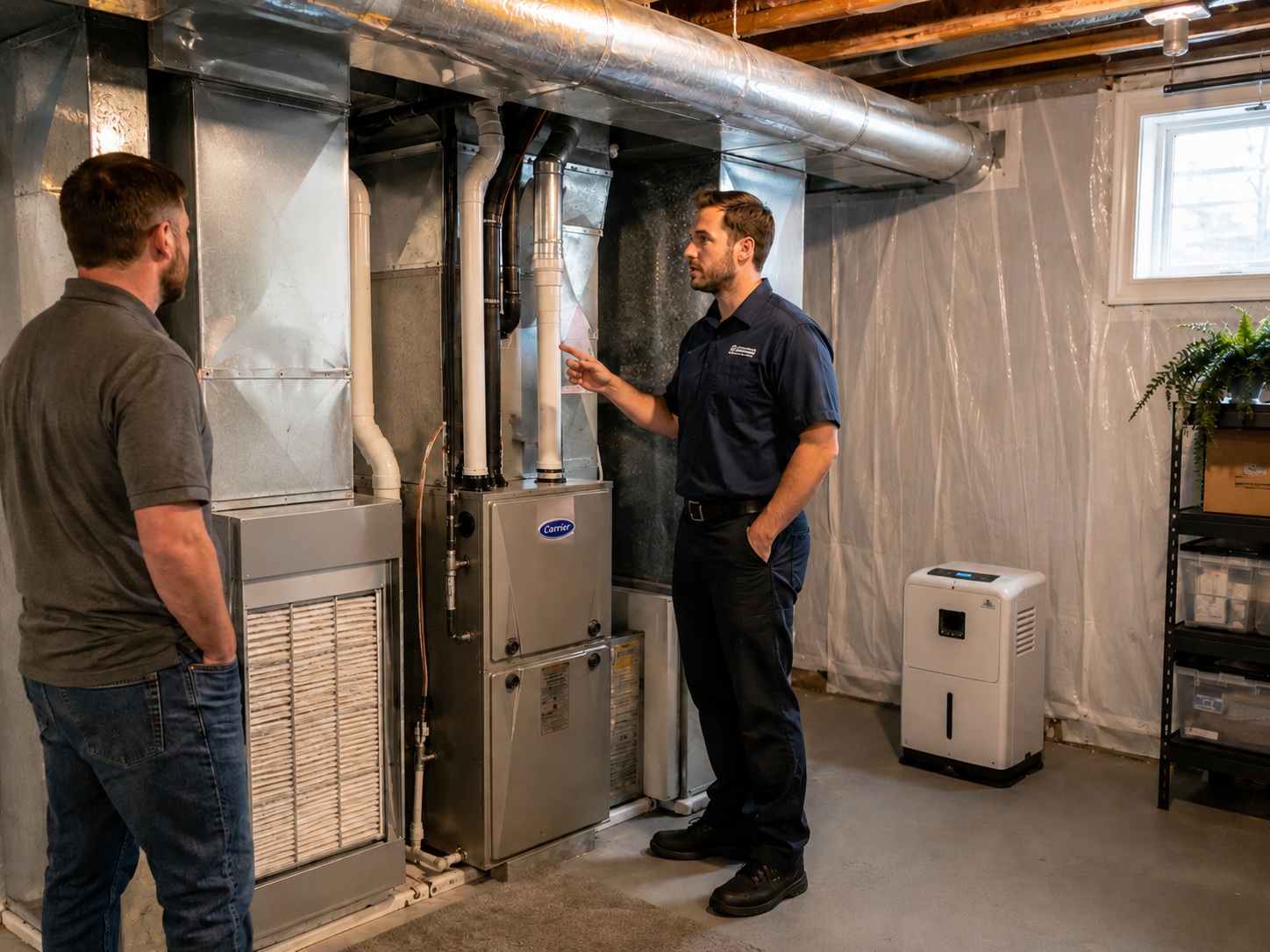
Basements, Humidity, and Musty AC Smells
Finished basements are one of the biggest indoor air quality factors in Overland Park. They add living space, but they also change how the house handles moisture and air movement. A basement can be cooler than the rest of the home, which means surfaces may stay closer to the dew point during humid weather. If outdoor humidity is high, drainage is poor, or air is not moving well, that basement can hold moisture even when the upstairs feels comfortable.
The tricky part is that basement moisture does not always look dramatic. It may not show up as standing water. It may show up as a slight odor near the stairs, a damp feeling in carpet, rust on metal storage items, sweating ducts, staining near baseboards, or a dehumidifier that seems to run constantly. If the HVAC system has returns in or near the basement, that air can get pulled into the system and mixed with the rest of the house.
Musty smells during air conditioning season are often blamed on “dirty ducts,” but the coil area deserves attention first. The evaporator coil gets cold, wet, and dark during cooling season. Dust and organic material can collect on the coil and drain pan. If the drain does not clear well or the coil stays damp for long periods, odor can develop. When the blower starts, the homeowner smells it at the vents and assumes the entire duct system is contaminated.
UV lights can be useful in this situation when they are installed correctly near the evaporator coil and drain pan. Their main value is helping control biological growth on damp HVAC surfaces. They are not a replacement for filtration, and they do not remove dust from the air by themselves. But in a humid cooling climate, especially in homes where the AC has a musty startup smell, UV can be a practical part of the solution.
Humidity control may involve more than one piece of equipment. A properly operating air conditioner should remove moisture during cooling, but basements may still need dedicated dehumidification. The home may also need better drainage outside, sealed duct leaks, improved return placement, or better airflow to basement rooms. Indoor air quality is often tied to building conditions that are not solved by the HVAC system alone.
Older Ranches, Split-Levels, and Newer Tight Homes
Overland Park has a wide mix of housing, and that changes the way air purification should be approached. Northern Overland Park has more older ranch homes, split-levels, smaller duct systems, and retrofit HVAC equipment. These homes may have returns that were never designed for today’s higher-efficiency systems or higher-MERV filters. They may also have more air leakage through attics, basements, wall cavities, and older construction details.
In those homes, dust complaints often start with air leakage and return-side problems. If the return duct is leaky, the system can pull dusty air from places the homeowner never sees. That air then passes through the blower and supply ducts and ends up in bedrooms, living rooms, and finished spaces. A better filter can help, but sealing return leaks and making sure the filter rack is tight may be just as important.
Central Overland Park has many homes from the 1970s through the 1990s. These homes often have finished basements, mixed insulation quality, and HVAC systems that have been changed over time. Additions, basement remodels, and equipment replacements can leave the duct system mismatched to the current layout. A room that used to be unfinished storage may now be a bedroom, office, or playroom, but the airflow may not have been redesigned for that use.
Southern Overland Park has many larger and newer homes. These homes can be tighter and more efficient, which is good for energy use, but tighter homes can hold onto indoor pollutants longer. New flooring, cabinetry, paint, cleaning products, furniture, attached garages, and hobby spaces can all add odors or VOCs. Larger homes may also have zoning systems, high ceilings, long duct runs, and rooms that are hard to balance. In those houses, the complaint may be stale air, uneven comfort, or one floor feeling different from another.
This is why air purification in Overland Park should not be treated as one standard package. A 1960s ranch near northern Overland Park does not behave like a large newer two-story home near southern Johnson County. Both may need better indoor air quality, but the path to get there can be different.
How Whole-Home Air Purification Fits Into the HVAC System
A whole-home air purifier works best when it supports the HVAC system instead of fighting against it. The HVAC system is already the main air mover in the house. It pulls air through returns, passes it through the filter area, conditions it, and sends it back through the supply ducts. That makes it the logical place to improve filtration and air treatment, but only if airflow is respected.
For allergy-heavy homes, HEPA filtration or a high-quality media filter can make a noticeable difference. HEPA is especially helpful for fine particles, pet dander, and allergy-sensitive families. In some homes, a bypass HEPA system can clean a portion of the air without putting too much restriction on the main blower. In other homes, a properly sized media cabinet with the right MERV rating may be the better fit.
MERV 11 to MERV 13 filters can be practical in many homes, but they should not be guessed into place. The duct system and blower need to handle the pressure drop. When a filter is too restrictive for the system, airflow drops. Low airflow can create comfort issues, noise, coil problems, furnace temperature rise issues, and higher energy use. Cleaner air is the goal, but not at the expense of proper equipment operation.
UV lights are best thought of as surface treatment inside the HVAC system. They are most useful near the evaporator coil and drain pan, where moisture and biological growth are more likely. They do not replace a good filter. They do not fix a damp basement. They do not remove pollen from carpet. But they can help keep wet HVAC surfaces cleaner during the humid cooling season.
Bipolar ionization and similar technologies should be viewed as supplements. They may help with certain odor and particle concerns, but they should not be the first or only step. A good indoor air quality plan starts with source control, filtration, humidity, ventilation, and HVAC maintenance. Once those basics are handled, supplemental air purification can make more sense.
What I Would Check Before Recommending Air Purification
Before recommending air purification equipment, I would want to look at the home like a system. Indoor air quality problems usually leave clues. The filter tells a story. The return grille tells a story. The coil, blower wheel, drain pan, basement, ductwork, humidity level, and homeowner complaints all point in a direction.
A few things worth checking include:
- Filter size, fit, MERV rating, and bypass gaps
- Return duct leakage or dirty return cavities
- Static pressure before and after filtration changes
- Evaporator coil cleanliness and drain pan condition
- Indoor humidity upstairs and in the basement
- Signs of garage, attic, or basement air entering the system
- Airflow balance between floors and finished basement areas
That kind of inspection helps prevent the wrong fix. If the house has a musty basement, installing a stronger filter may not solve the odor. If the return duct is pulling attic dust, an air purifier may help but still leave the source untouched. If the coil is dirty and wet, duct cleaning alone may miss the real odor source. If the home is newer and stale, ventilation may matter more than adding another particle-control device.
The best results usually come from lining up the solution with the complaint. Dust and allergies point toward filtration. Musty AC odor points toward coil condition, drainage, UV, and humidity. Dry winter complaints point toward humidification and particle control. Stale air points toward ventilation. Basement smells point toward moisture control and pressure movement. Once the cause is understood, the equipment choice becomes much clearer.
Practical Indoor Air Quality Advice for Overland Park Homeowners
For many Overland Park homeowners, the best first step is not buying the most expensive air purification product. It is understanding what the home is doing. Check how quickly the filter loads. Pay attention to whether symptoms happen in spring, summer, fall, or winter. Notice whether odors are worse when the system first starts, after rain, during cooling season, or when the basement door is open. Those details matter.
A homeowner with allergies near mature trees may need better filtration and a tighter filter cabinet before anything else. A family with dogs and kids may need stronger particle capture and more consistent filter changes. A home with a finished basement may need humidity readings in different areas of the house. A newer home with lingering odors may need ventilation and source control. A home with a musty AC smell may need the evaporator coil, drain pan, and UV placement evaluated.
Air purification is not about making a house perfect. Homes are lived in. Doors open. Pets shed. Kids track things in. Cooking creates particles. Basements hold moisture. The goal is to reduce the load on the home and help the HVAC system do a better job of managing the air that moves through it every day.
When air purification is done correctly, it feels less like adding a gadget and more like correcting how the house handles air. The filter fits tight. The return side is cleaner. The coil stays cleaner. Humidity is kept in a better range. The basement does not feed odors into the main living area. The system can still move the right amount of air. That is when homeowners usually notice the difference.