

.svg)


A look into Kansas City's Air Quality
Kansas City homes deal with a strange mix of air quality problems because the city sits right where several different environments meet. We get humid Gulf air in the summer, cold dry air in the winter, strong spring pollen, fall ragweed, prairie wind, traffic corridors, construction dust, and the occasional wildfire smoke day that makes everybody suddenly start looking at their furnace filter. That combination matters because indoor air quality is never just about what is floating around outside. It is about how that outdoor air gets into the house, how the HVAC system moves it around, how well the filter catches it, and what the basement, crawl space, attic, ductwork, and living space add to the problem.
One thing I notice in many Kansas City homes is that homeowners usually describe the symptom before they know the cause. They say the house feels dusty. They say the upstairs never feels right. They say the basement smells musty after it rains. They say allergies get worse even when they stay inside. They say the filter gets dirty fast, or the air feels dry in the winter, or one room always smells stale. Those complaints are real, but they usually have more than one cause working together.
Air purification in Kansas City has to be looked at as part of the whole house. A whole-home air purifier can help, but it should not be treated like a magic box that fixes every problem by itself. Sometimes the bigger issue is a leaky return pulling basement air into the system. Sometimes the filter rack is too small for the filter the homeowner is trying to use. Sometimes the evaporator coil is dirty because summer humidity keeps it wet for months. Sometimes the home needs dehumidification more than it needs another air cleaner. The right answer depends on what the house is actually doing.

Why Kansas City Homes Have Their Own Indoor Air Quality Pattern
Kansas City is not a desert climate, and it is not a coastal climate. It has hot, humid summers, cold winters, wet springs, windy stretches, and enough seasonal change to make a house behave differently month to month. That is one reason indoor air quality complaints here can be hard for homeowners to pin down. A house that feels fine in February can smell damp in June. A filter that looks normal in winter can load up quickly during spring pollen. A basement that seems dry most of the year can start smelling musty after several heavy rains.
The spring season is one of the first big indoor air quality stress points. Tree pollen from oak, maple, cedar, elm, ash, sycamore, cottonwood, and other local vegetation starts showing up outside, and it does not stay outside. It comes in through open windows, loose doors, pets, clothing, attic bypasses, return leaks, and general air leakage. A lot of homeowners assume pollen only matters when windows are open, but that is not how most houses work. If the return side of the duct system is leaky, the HVAC system can pull air from basements, wall cavities, attics, or other dusty spaces every time the blower runs.
By summer, humidity becomes the bigger issue. Kansas City summers can be muggy, and that moisture affects the house in ways people do not always connect to air quality. Higher humidity makes dust feel heavier, lets odors linger longer, and increases the chance of mold growth on damp surfaces. The evaporator coil inside the HVAC system stays wet during cooling season, which is normal, but a dirty wet coil becomes a place where biological growth and odor problems can start. If the condensate drain is partially plugged or the pan is dirty, that problem gets worse.
Fall brings its own set of complaints. Ragweed, weed pollen, leaf decay, and outdoor mold spores can hit at the same time. This is when a lot of homeowners say, “I thought allergy season was over.” In Kansas City, fall can be just as rough as spring for some people. The system may not run as steadily during mild shoulder-season weather, so air movement and filtration can be less consistent. That means particles and odors may sit in the house longer instead of being pulled through the filter regularly.
Winter flips the problem again. Cold outdoor air holds less moisture, and when that air leaks into the house and gets heated, indoor humidity can drop fast. That is when people start noticing dry noses, static electricity, cracked wood, dry skin, and that sharp dry-air feeling when the furnace runs. Whole-home humidifiers can help, but they have to be set carefully. In older Kansas City homes, too much humidity in winter can cause condensation on windows, inside wall cavities, or around poorly insulated areas. Comfort matters, but moisture control matters too.
The Kansas City Dust Problem Is Usually More Than Housekeeping
Dust complaints are some of the most common indoor air quality concerns in Kansas City homes. Homeowners will say they dust the furniture and it comes right back. They will show a dark return grille, a gray filter, or a film on shelves near supply vents. It is easy to blame the filter right away, but the filter is only one part of the system. Dust usually comes from a combination of infiltration, duct leakage, poor filter fit, basement conditions, pets, people, carpet, construction debris, and weak return design.
Older homes in areas like Brookside, Waldo, Hyde Park, Midtown, Northeast Kansas City, and Westport often have duct systems that were never designed with modern filtration in mind. Many were built when airflow and heating capacity were the main concerns, not high-efficiency filtration, static pressure, or sealed return systems. You may see a 1-inch filter slot with gaps around the filter, old panned joist returns, basement ductwork with loose seams, or return paths that pull from areas they should not be pulling from. Once that happens, the HVAC system becomes part of the dust distribution system.
Some of the most common dust-related issues I would look for in a Kansas City home include:
- Loose or poorly sealed return ductwork
- Gaps around the furnace filter or filter rack
- High-MERV 1-inch filters restricting airflow
- Dusty basements or open framing cavities connected to returns
- Attic or crawl space air being pulled into the system
- Dark dust near homes close to highways, rail yards, or busy roads
That last point matters in parts of the metro near I-70, I-35, I-435, I-29, US-71, the downtown loop, industrial corridors, warehouses, and rail areas. Outdoor particles from traffic, tires, brakes, diesel exhaust, construction, unpaved areas, and general city activity can make their way indoors. Homes near heavier traffic may collect darker dust faster, especially if the house is leaky or the HVAC system has return-side problems.
A better filter can help, but it has to be matched to the system. A MERV 11 or MERV 13 filter can catch more fine particles than a cheap fiberglass filter, but if it is squeezed into a restrictive 1-inch rack on a system that already struggles for return air, it can create airflow problems. That can reduce comfort, increase static pressure, strain the blower, and sometimes even contribute to coil freezing or poor temperature control. In many homes, the better fix is not just “use the strongest filter.” It is to improve the filter cabinet, increase filter surface area, seal return leaks, and then use a filter the system can actually handle.
Allergies, Pollen, Mold Spores, and What Gets Pulled Indoors
Kansas City is a tough area for allergy-sensitive homeowners because the seasons stack on each other. Spring tree pollen rolls into summer grass pollen, then fall ragweed and mold spores show up. Add humidity and wind, and you have a long stretch of the year where outdoor particles are constantly trying to get inside. Once those particles enter the home, the HVAC system either helps control them or spreads them around.
Spring tree pollen is usually the first wave people notice. It settles on cars, porches, windowsills, pets, and clothing. When homeowners open windows on a nice day, pollen gets a direct path inside. But even when windows stay closed, pollen can still enter through air leaks. Every house has some leakage. Older Kansas City homes often have more of it, especially around rim joists, attic penetrations, basement windows, old doors, and utility openings.
Grass pollen tends to become more noticeable as lawns grow and mowing season kicks in. Pets can bring it in. Kids can bring it in. Shoes and clothing can bring it in. If the HVAC system has a good filter setup and enough runtime, some of that material gets captured. If the filter fits poorly or the return duct leaks before the filter, a surprising amount can bypass filtration altogether.
Mold spores are a little different because they can come from outside and inside. Outdoors, they increase after rain, leaf decay, and humid weather. Indoors, they are usually tied to moisture. In Kansas City homes, that often means basements, crawl spaces, dirty evaporator coils, clogged condensate drains, wet carpet, damp framing, or storage areas with poor air movement. A musty smell is not something I would ignore. It does not always mean there is a major mold problem, but it does mean moisture and organic material are interacting somewhere.
A lot of allergy complaints are really filtration and air pathway complaints. The homeowner may think the house needs a portable air purifier in every bedroom, when the real issue is that the central system is pulling dusty basement air through a leaky return. Portable units can help in specific rooms, especially bedrooms, but they do not correct a whole-house air movement problem. That is why a good indoor air quality evaluation should include the HVAC system, ductwork, filter setup, humidity level, and building leakage.
Basements, Humidity, and Musty Air in Kansas City Homes
Basements are one of the biggest indoor air quality clues in Kansas City. Many older homes have them, and they often tell you what is happening before the living space does. If the basement smells damp, the upstairs may eventually smell damp. If the basement has dusty returns, that dust may end up in bedrooms. If the basement humidity stays high through summer, the whole house can feel less clean even when the air conditioner is running.
Heavy spring rain and humid summer air are the main drivers. Water can come from poor grading, clogged gutters, foundation seepage, cracks, sump issues, or just a naturally damp foundation. Even when there is no standing water, concrete and masonry can hold moisture. Stored cardboard, old carpet, wood shelving, and fabric furniture in a damp basement can all hold odors. Once the HVAC system pulls return air from that space or leaks around basement ductwork, those odors can move through the home.
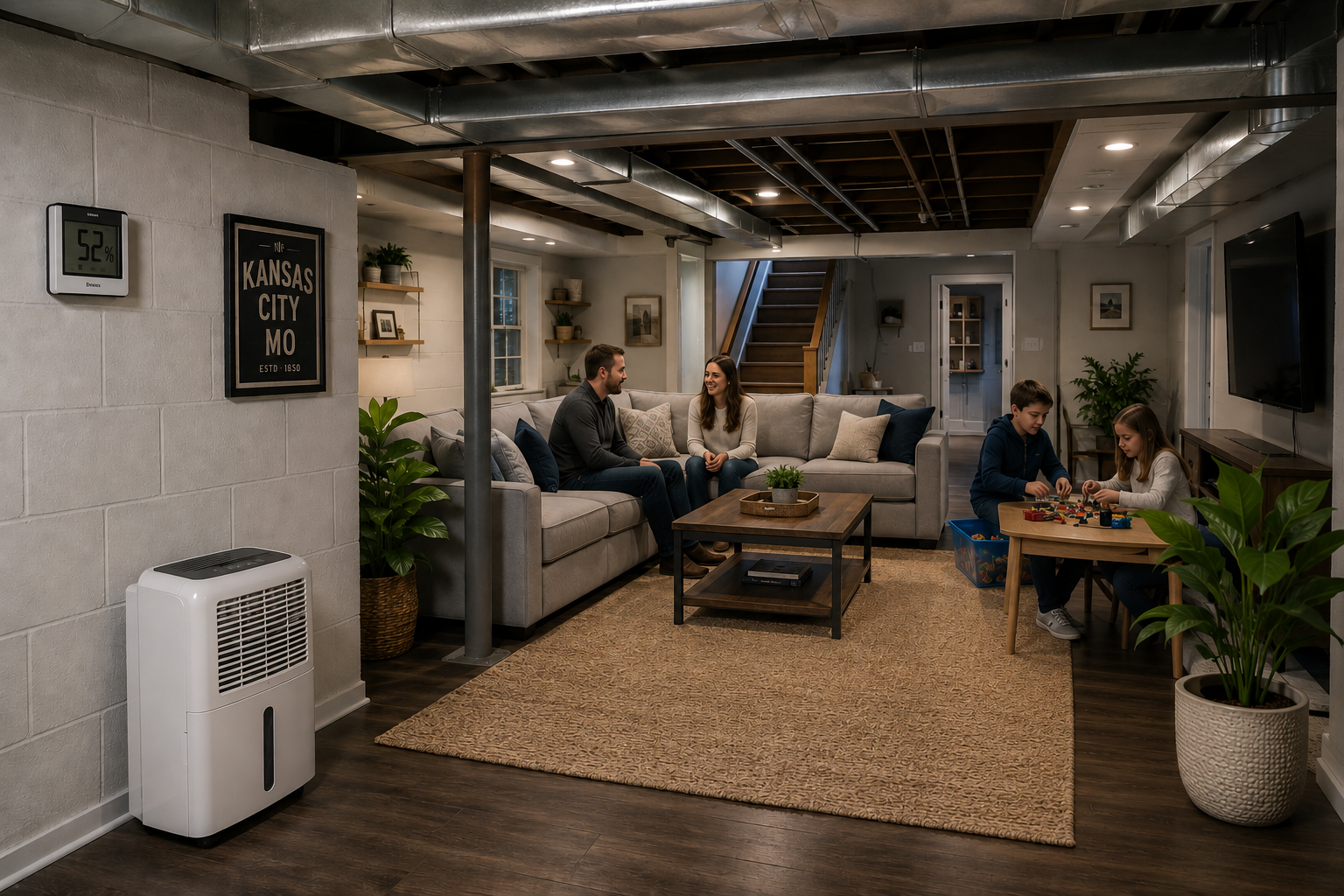
In cooling season, the air conditioner removes moisture as it runs, but it is not always enough. If the system is oversized, it may cool the house quickly without running long enough to pull out much humidity. That leaves the homeowner with a house that reaches the thermostat setpoint but still feels sticky. This is common in homes where equipment was replaced based mostly on rough sizing or where insulation and windows have changed over time but the HVAC design did not get revisited.
A few signs that humidity may be affecting indoor air quality include:
- Musty odor after rain or during summer
- Basement humidity staying above comfortable levels
- Condensation on cold ducts, pipes, or windows
- Allergy symptoms that worsen in damp areas
- Visible dust sticking to supply grilles or surfaces
- A clammy feeling even when the thermostat says the house is cool
For many Kansas City homes, dehumidification is just as important as air purification. A good basement dehumidifier or a properly designed whole-home dehumidifier can make a major difference when humidity is the root problem. The target is usually around 40–50% indoor relative humidity. Too low and the house feels dry. Too high and odors, dust mites, and mold risk become harder to control.
UV lights can also make sense in certain Kansas City systems, especially at the evaporator coil. The coil is wet during cooling season, and wet surfaces collect dust and biological growth more easily. A properly installed UV system can help keep that coil surface cleaner. That does not mean UV is cleaning every cubic foot of air in the house like some people imagine. It is more accurate to say it helps control growth on surfaces inside the air handler, especially where moisture is present.
Older Homes, Newer Homes, and Why the Same Air Cleaner Does Not Fit Every House
Kansas City has a wide range of housing styles, and that makes indoor air quality different from one home to the next. A 1920s Brookside home does not behave like a newer subdivision home in the Northland or Lee’s Summit. A Waldo bungalow with basement ductwork does not behave like a slab-on-grade ranch. A split-level in Raytown or Independence may have very different airflow problems than a two-story home near the Plaza. That is why the same air purification setup should not be recommended blindly for every house.
Older homes often have more natural air leakage. Some of that leakage happens through the attic and upper levels as warm air rises. Some happens through the basement and lower levels as the house pulls replacement air in. This stack effect can move basement odors, dust, and outdoor air into the living space. If the HVAC return system is also leaky, the blower can make that movement stronger.
Older duct systems may also have undersized returns. When a system does not have enough return air, it will pull from wherever it can. That may mean gaps around filter doors, return chases, basement cavities, or other unsealed openings. Homeowners may notice whistling filters, slamming doors, uneven temperatures, or rooms that never get comfortable. Poor airflow and poor air quality often show up together because the same duct problems affect both.
Newer homes bring a different set of issues. They are often tighter, which can be good for energy efficiency and outdoor particle control, but tighter homes need better ventilation strategy. New flooring, cabinets, paint, adhesives, furniture, and cleaning products can release VOCs. If the home does not get enough controlled fresh air, odors can linger. In those cases, filtration alone may not solve the complaint because some gases and odors are not captured well by a standard particle filter.
Split-level homes and homes with additions can be especially tricky. Air does not always move evenly through those floor plans. A basement or lower level may smell musty while the upper level feels warm. One return may serve too much of the house. A finished basement may cover duct problems that were easier to see before the space was finished. These homes often need a closer look at airflow, pressure, return pathways, and humidity before deciding on equipment.
This is where whole-home air purification should be treated as a system design question, not a product choice. A larger media filter cabinet, sealed return ductwork, a whole-home HEPA bypass system, UV coil treatment, dehumidification, or controlled ventilation may all be useful, but not for the same reason. The equipment should match the complaint and the house.
How Whole-Home Air Purification Fits Into a Kansas City HVAC System
A whole-home air purifier works best when it is chosen after the real problem is understood. If the issue is pollen and dust, filtration is usually the first place to look. If the issue is musty odor, humidity and moisture sources have to be addressed. If the issue is coil growth, UV may be useful. If the issue is stale air or VOCs in a newer home, ventilation may need to be part of the conversation. The mistake is trying to solve every indoor air quality problem with one device.
For particle control, a properly installed media filter cabinet is often a major upgrade over a standard 1-inch filter. The thicker filter gives more surface area, which usually means better particle capture with less restriction than forcing a high-MERV filter into a small slot. For many Kansas City homes with dust and allergy complaints, this is one of the most practical improvements. It helps with pollen, pet dander, larger dust particles, and some fine particles, depending on the filter rating and system design.
Whole-home HEPA filtration is another option, but it needs to be applied correctly. True HEPA filtration is very restrictive, so it is usually installed as a bypass or dedicated system rather than as a direct replacement for a normal HVAC filter. This can be helpful for homeowners with stronger allergy concerns, smoke sensitivity, fine dust complaints, or pets. It is not something I would just shove into a standard filter rack and hope the blower can handle it.
Different IAQ tools solve different problems:
- MERV 11–13 media filters help with pollen, dust, and pet dander when airflow allows it
- Whole-home HEPA systems help with finer particles when installed correctly
- UV lights help keep wet coil surfaces cleaner during humid cooling seasons
- Dehumidifiers help with damp basements, musty smells, and mold pressure
- Controlled ventilation helps with stale air, odors, and VOC-heavy newer homes
- Air sealing helps reduce pollen, dust, basement odor transfer, and outdoor infiltration
Ionization is one of those products that needs a careful explanation. It can help in some applications with odors and particle behavior, but it should not be sold as the first answer for every dust or allergy complaint. If a homeowner has a leaky return, poor filtration, and a damp basement, ionization is not the root fix. It may be part of a broader setup, but the basics still matter: clean airflow, sealed ducts, correct filtration, controlled humidity, and proper maintenance.
Maintenance is also part of air purification. A dirty blower wheel, dirty evaporator coil, clogged condensate drain, loose filter door, or poorly fitted filter can undo a lot of good equipment. In Kansas City’s humid cooling season, coil cleanliness and drain maintenance matter more than many homeowners realize. If the coil stays dirty and wet, the system can develop odors and lose performance. If the filter bypasses air, dust builds up inside the equipment instead of being captured.
What I Would Look at Before Recommending an Air Purifier
Before recommending air purification in a Kansas City home, I would want to understand what the homeowner is actually experiencing. Is the complaint dust, allergies, odor, humidity, smoke, pet dander, dry air, or stale air? When does it happen? Is it seasonal or constant? Does it get worse after rain? Does it happen when the blower runs? Is the basement involved? Does the filter get dirty evenly, or is air bypassing around it?
Then I would look at the equipment. The filter rack tells you a lot. If the filter is bent, sucked inward, dirty only on one section, or surrounded by gaps, the system is not filtering correctly. The return duct tells you even more. If return leaks are pulling from a basement, mechanical room, crawl space, or wall cavity, the homeowner may be filtering only part of the air while the rest bypasses the system.
Static pressure matters too. This is where homeowners can get into trouble with high-MERV filters. They buy a better filter because they want cleaner air, but the system was not designed for that restriction. The result can be weaker airflow, longer run times, noisy returns, frozen coils, or comfort complaints. A better setup may require a larger filter cabinet rather than simply a stronger filter.
Humidity readings are just as important. If a Kansas City basement is sitting at high humidity during summer, air purification alone will not fix the musty smell. If the upstairs is dry in winter, a humidifier may help, but it needs to be set based on outdoor temperature and window condensation risk. Indoor air quality is not just particles. Moisture is one of the biggest drivers of how a home smells and feels.
The best results usually come from combining the right improvements. That may mean sealing returns, upgrading the filter cabinet, adding a properly selected media filter, cleaning the coil, maintaining the drain, controlling basement humidity, and then considering UV, HEPA, or ventilation where appropriate. None of that sounds flashy, but it is how real indoor air quality problems get solved.